 1952
OXO
1952 video game: naughts and crosses simulator
Original description from the source, not translated.
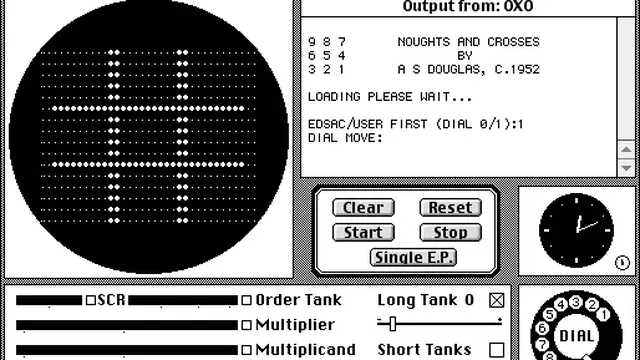
OXO is a video game developed by A S Douglas in 1952 which simulates a game of noughts and crosses (tic-tac-toe). It was one of the first games developed in the early history of video games. Douglas programmed the game as part of a thesis on human-computer interaction at the University of Cambridge. The program was written for the Electronic Delay Storage Automatic Calculator (EDSAC). EDSAC was one of the first stored-program computers, with memory that could be read from or written to, and had three small cathode-ray tube screens to display the state of the memory; Douglas re-purposed one screen to demonstrate portraying other information to the user, such as the state of a noughts and crosses game. After the game served its purpose, it was discarded on the original hardware but later successfully reconstructed. OXO, along with a checkers game by Christopher Strachey completed around the same time, is one of the earliest known games to display visuals on an electronic screen. Under some definitions, it thus may qualify as the first video game, though other definitions exclude it due to its lack of moving or real-time updating graphics.
Source: Wikipedia CC BY-SA 4.0 — OXO (video game) · retrieved October 19, 2026
Fields on this page come from the catalog record and recorded sources. No popularity or rating claims are added.
- Wikidata / Q731466 live · October 12, 2026
- wikipedia (en) / OXO (video game) live · October 19, 2026
- wikipedia (id) / OXO (permainan video) live · October 19, 2026
- Developer
- Sandy Douglas
- Publisher
- University of Cambridge
- First release
- January 1, 1952
- Series
- Not recorded
- Cover
- Official thumbnail
- Record ID
- Q731466
TIME SHELF